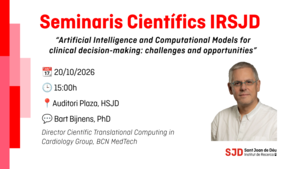
Artificial Intelligence and Computational Models for clinical decision-making: challenges and opportunities
IRSJD October Scientific Seminar: "Artificial Intelligence and Computational Models for clinical decision-making: challenges and opportunities". Dr. Bart Bijnens, PhD, Scientific Director of the Translational Computing in Cardiology Group, BCN MedTech. Host: Dr. Marta Camprubi, Neonatology Research Group (GReN).
Abstract
The use of AI and Computational Models to target clinical problems is called to revolutionize clinical decision-making, with a lot of applications published in cardiology. The success of these tools is dependent on the interplay of the understanding of the intrinsic processes being used during the conventional pathway by which clinicians make decisions and the potential and limitations of the algorithms used. In a parallelism with the clinical decision-making pathway, data, as well as physiological, models can have an impact at four levels: for data acquisition, predominantly by extracting standardized, high-quality information with the smallest possible learning curve; for feature extraction, by discharging healthcare practitioners from performing tedious measurements on raw data; for interpretation, by digesting complex, heterogeneous data in order to augment the understanding of the patient status; and for decision support, by leveraging the previous steps to predict clinical outcomes, response to treatment or to recommend a specific intervention. We will discuss the state-of-the-art, as well
as the current clinical status and challenges associated with the two later tasks of interpretation and decision support, together with the challenges related to the learning process, the auditability/traceability, the system infrastructure and the integration within clinical practice.
Short biography
Since establishing her independent research group in 2019, following two maternity leaves, Dr. Javierre has built a multidisciplinary research programme integrating expertise in cell differentiation, cancer biology, epigenetics, and three-dimensional genome organization to uncover the regulatory mechanisms governing normal and malignant haematopoiesis. Her laboratory, based at the Josep Carreras Leukaemia Research Institute
Dr. Javierre has built a strong international scientific network and demonstrated outstanding leadership, earning recognition as one of the most promising young investigators in her field. Her achievements have been acknowledged through prestigious awards, including the L'Oréal-UNESCO For Women in Science Research Award (2018), the L'Oréal-UNESCO International Rising Talents Award (2019), the PharmaMar Foundation Young Investigator Award (2024), and the Scientific Talent Award from the Spanish Royal Academy of Sciences (2025).